
Stop Picking Two. Here’s Why the Old Saying Is Killing Your Business.
The “pick two” mental model assumes a static, transactional view of work. One project. One budget. Fixed resources. Zero relationship context. That’s not how durable businesses are built.

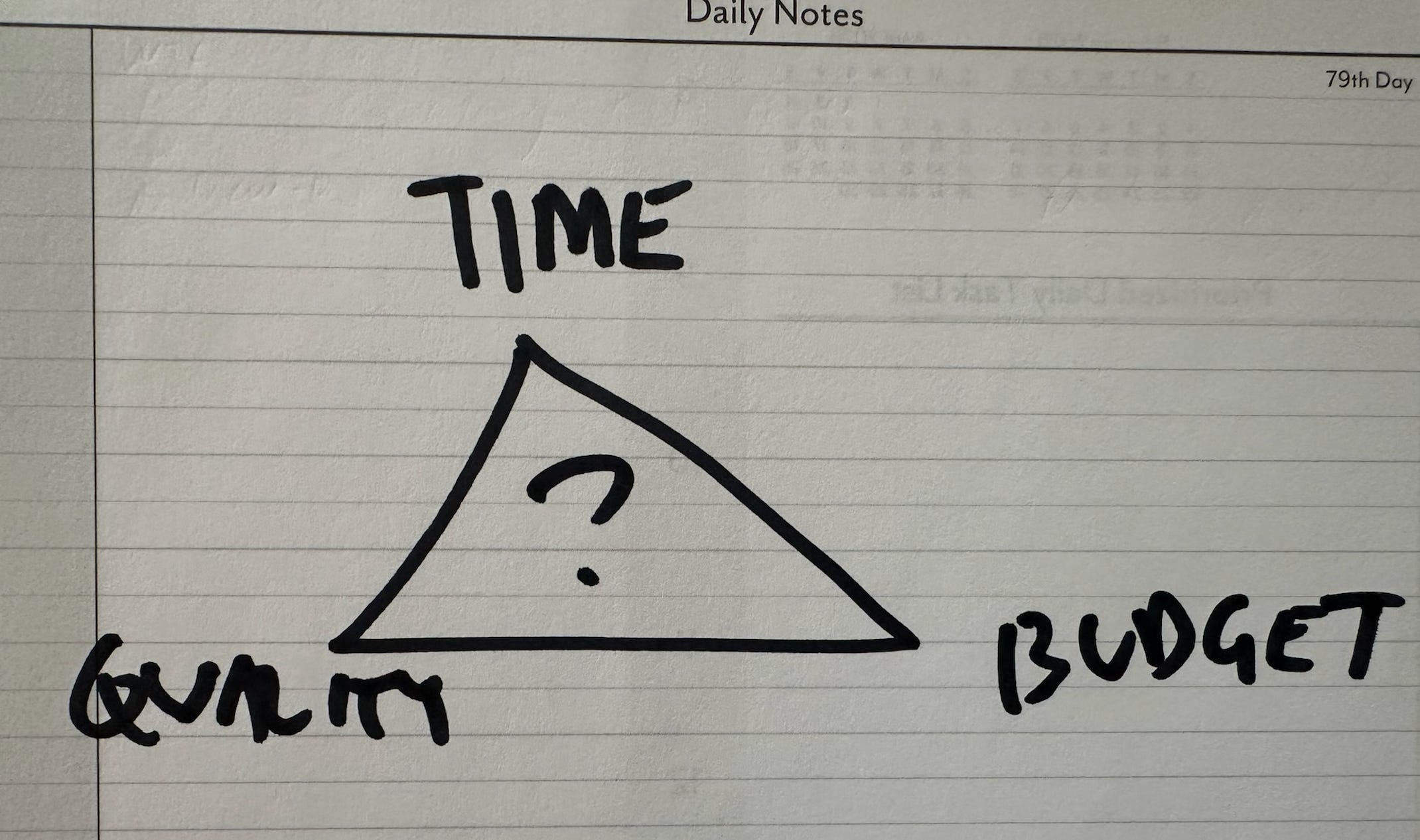
You’ve heard it a thousand times. Someone draws a triangle on a whiteboard — Budget, Quality, Timeline — and says with a knowing smirk: “Pick two.”
It’s treated like immutable law. A clever little trap that makes you feel wise for acknowledging the constraint.
I’ve stopped repeating it to my team. In fact, I push back on it directly.
Don’t pick two. Here’s how to think about it instead — and which leadership behaviors make it work.
1. Timeline Is Not Negotiable. Full Stop.
In a service business, your timeline isn’t a preference — it’s your reputation. Every missed deadline is a data point your clients store quietly. They may not say anything in the moment. They may even tell you it’s fine. But missing a deadline is what makes your client look bad to their customers and stakeholders and when the next project they have comes up, or when a competitor shows up, that memory surfaces.
This is where Accountability (#10) is the foundation stone. Solid as a rock. Accountability starts with personal accountability — being true to yourself and following through on your own realistic commitments — and then learning how to hold others accountable. When your team truly respects time, decision-making accelerates and ownership becomes natural.
But accountability alone isn’t enough. You also need to be Proactive & Responsive (#9). The anti-behavior here is being reactive and pressured. And here’s the thing: the emotional energy you project as a leader flows directly to your team. If you’re scrambling, they’re scrambling. If you’re calm and structured, they find their cadence too.
“In structure we find our freedom to be creative and get into flow.”
Leaders who hit deadlines consistently are not lucky. They plan deliberately. They do their #SundaySpecial. They’re never surprised by Thursday.
Which brings us to Smartly Anticipates (#8). Chronic surprise — “nobody told me” — is an anti-behavior I have zero tolerance for. High-performing Rocketeers see it coming. They read the market, they read the project, they read the room. They understand that the warning signs were always there — they just weren’t paying attention.
2. Quality Should Be Acceptable, Not Perfect
This is where people get uncomfortable, so let me be precise.
Acceptable quality is not low quality. It’s not cutting corners. It’s delivering at the standard your client actually needs — not the standard that makes you feel good about yourself.
Perfectionism is a budget killer disguised as professionalism. I’ve seen teams blow their margins obsessing over details the client never asked for and will never notice. The anti-behavior I watch for here is “Finds Excuses / Over Analyzes”— the opposite of Deliberate & Decisive (#7).
Deliberate & Decisive is my personal favorite of the ten behaviors. It’s about synthesizing information quickly, trusting your instincts, and focusing on What’s Important Now (W.I.N.). Watch for the phrase “but what about?” in your team’s vocabulary. That’s the tell. It introduces delays, confusion, and frustration — and it usually comes dressed up as diligence.
The surfer analogy applies here. Expert surfers don’t spend all day analyzing every wave. They check the conditions, make a call, paddle hard. They can adjust mid-wave. The key is committing and moving.
To define what “acceptable” actually means, you need to be a Good Listener (#4). Understand what the client is actually asking for — not what you imagine they want, not what would make a great portfolio piece. Listen. Confirm. Deliver to that standard. Then get out of your own way.
And to execute it well, you need to Empower Others (#3). Micromanagement is the enemy of speed and quality. Trust your team. Clarify the standard, give them the space to hit it, and resist the urge to hover. Leaders who empower others create teams that don’t need to be told twice.
3. The Money Takes Care of Itself — If You Do the First Two Right
Here’s the part the triangle ignores entirely: budget is a lagging indicator, not a leading one.
If you lead with budget — protecting margin above everything else — your service will suffer. Your team will feel it. Your clients will feel it. You’ll start making decisions that optimize for cost instead of for the relationship. And the moment a client senses you’re thinking about yourself more than them, you’ve already started losing them.
This is the anti-behavior of Servant Leader (#6) in practice. Self-centricity — prioritizing your own advancement or your own P&L over the team’s wellbeing and the client’s success — is exactly what erodes the relationships that pay the bills. The African proverb says it well: If you want to go fast, go alone. If you want to go far, go together.
The real model is simpler: relationship and volume are how you make money. Clients stay. They refer others. Your volume grows. Your cost structure improves over time. The economics follow the behavior.
That only happens when your Rocketeers are Developing Rocketeers (#2). Growing your people is not a nice-to-have — it’s the engine of scalable delivery. A team that is constantly developing delivers better, faster, and with more consistency. Deferring development is deferring your business’s future.
And it starts before any of that with being a Team Builder (#1). The clients you’re trying to retain and grow — they don’t just experience your service. They experience your team. Diverse perspectives, deep relationships with team members, a positive climate — these are not soft things. They are how you build a team that clients want to come back to.
The Behavior That Holds It All Together: Stable Confidence
There’s one behavior that cuts across all three legs of the triangle, and it doesn’t get enough credit: Stable Confidence / Calm Presence (#5).
When timelines get tight — and they will — someone on your team will panic. The question is whether that panic escalates or dissolves. Leaders with stable confidence regulate the room. They don’t fake certainty, but they don’t amplify fear either. They hold the line.
Calm is contagious. So is anxiety. Choose deliberately.
The Triangle Isn’t Wrong. It’s Just a Trap for the Short Game.
The “pick two” mental model assumes a static, transactional view of work. One project. One budget. Fixed resources. Zero relationship context.
That’s not how durable businesses are built.
When you shift your thinking to the long game — repeated delivery, growing trust, expanding scope — the triangle stops being useful. You’re not trading off three constraints. You’re stacking the variables in the right order: timeline first, acceptable quality second, revenue as the outcome.
And you’re doing it with a team of Rocketeers who are accountable, decisive, anticipatory, proactive, empowered, good listeners, servant-minded, team builders, developing each other, and calm under pressure.
Ten behaviors. One direction.
Stop picking two.
Luck favors the persistent. Build the team, hit the dates, serve the client — the rest follows.