

Planning is about having good habits, not about being perfect. You aim to keep improving. Sometimes you get busy, you get sucked into the flow and you’re creative and executing. That’s ok, when the busy spell is over or you feel it’s right, take a deep breath and get back on the horse. 🐴.
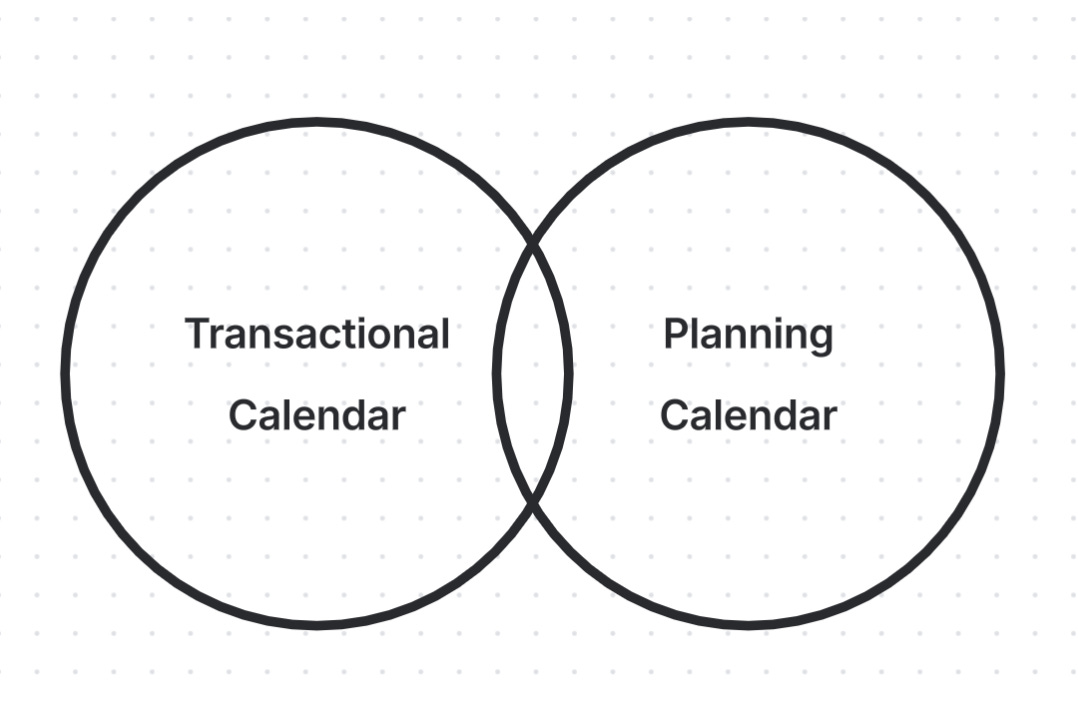
On top of this, for many years now I’ve been running 2 calendars. One looking forward into the future and one day to day. I call these the Transactional and the Planning Calendars.
The Transactional Calendar
The first calendar is the Transactional Calendar. This is your day-to-day calendar that contains your appointments, meetings, scheduled tasks, blocks and reminders. It’s your default calendar. You plan using Time: hours/minutes. You could also call this your Appointment Calendar.
The Planning Calendar
The second calendar is a new one you’ll create - it’s the Planning Calendar. This is your view ahead of your plan. This one contains WHERE you need to be and things you WANT to attend. You plan in this calendar using all-day and multi-day events. You have finite resources (Time, Energy, Attention, Money) and the Planning Calendar is where you decide where you will place these resources.
Principles:
Principle 1 - Reduce Negative Anxiety.
Ever seen someone that seems so much on top of their stuff that they are always emanating positive energy? Why is that way, when we all get the same 86,400 seconds in a day? Chances are that they understand how to invest in planning so that they can reduce this negative anxiety and instead be more present and creative.
Principle 2 - Reduce Context Switching.
This one is obvious!
Principle 3 - If it doesn’t go through your plan, it won’t go through your brain. AKA Resist trying to automate everything!
If you automate everything then you just become a slave to the day-to-day without any control of your strategic direction, that is the whole intent of the Planning Calendar.
Everything that is on your Planning Calendar has to pay RENT, that is it has to have MEANING to make it on your Planning Calendar, if things appear automatically then you don’t OWN it. “I didn’t put that there?” “what is that?” those questions should not occur with your Planning Calendar.
Your Planning Calendar is for YOU. Your department may have one as well, e.g. Marketing or IT etc, those Department Planning Calendars also should not be (totally) automated and should drive what we want to achieve, and then connect into $$$ BUDGETS. (You can see if things automatically appear then you won’t have control of your spend of resources (Time, Energy, Attention, Money).
Think about PROACTIVE items to go here, possibly some of your quarterly Goals too.
Why not just use the 1 calendar?
Let’s list a few reasons:
Let’s go to Principle 2 - Reduce Context Switching. Often times I’m doing planning as a distinct activity. Usually with chocolate! 🍫 - In fact, one of the key things I do when I am feeling stressed is to go back to my planner. It reminds me of traffic. Traffic can be very stressful - it’s all context. If you’re sitting in the middle of the city in a sea of red lights and honking horns and you are late for an appointment. Traffic is pretty stressful. But sitting on a lookout, casting your gaze over the city and seeing all the lights of that same traffic, it can seem peaceful and relaxing. Just like that, you can use your planner to zoom out and get the bigger picture. You’re going to be ok.
I can share my planner with key people without then needing to see all the details. Some examples are family members and coaches. My triathlon coach plans my workouts and he can see my planner so he knows where I’ll be and the bigger rocks on my calendar. So he won’t plan a 4 hour bike ride on the day I’m traveling.
Do you try and slam everything into 1 calendar? Give this system a try. In a future article, I’ll cover the next steps of my process.
Related Leadership Behaviors:
Rocketeer Leadership Behavior 9 - Proactive & Responsive

Our ninth Leadership Behavior is Proactive & Responsive and it builds nicely upon the previous leadership which is Smartly Anticipates. It differs though in that it centers around habits, cadences and getting yourself into a good state of flow, so that you impact those around you to do the same. When you work around someone that has this dialed in, you …
See part 2! https://open.substack.com/pub/leadershipbehaviors/p/plan-like-a-boss-part-2-snowball?r=2qew8&utm_medium=ios&shareImageVariant=overlay